
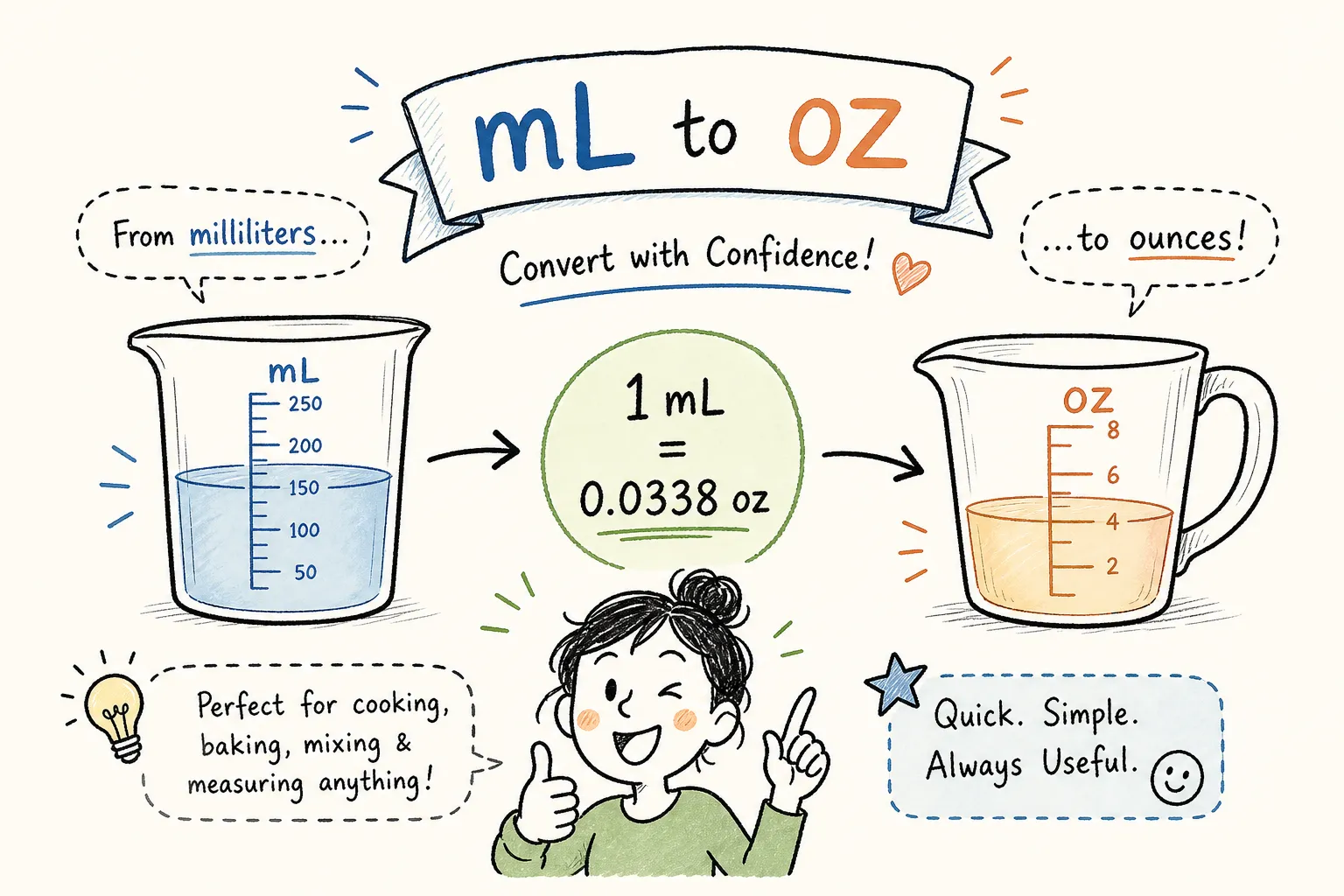
To convert milliliters to fluid ounces, multiply the milliliter value by 0.0338, or divide it by 29.57. That is the whole formula, and it is the same math whether you are reading a cough syrup label, a skincare bottle, or a metric recipe. One US fluid ounce is 29.5735 ml, so a 250 ml bottle works out to about 8.45 fl oz.
The United States runs mostly on fluid ounces for liquid volumes, while product labels, international recipes, and medical dosing charts use milliliters as the standard. That gap shows up in medicine cabinets, kitchen drawers, and airport security lines. The good news is that moving between the two units is simple once you know the formula and one important distinction about which ounce you are actually converting to. If you would rather skip the arithmetic, the ml to oz converter does it instantly, but the manual method is worth knowing, and that is what this guide covers.
How the ml to oz formula works
The exact conversion factor is 1 ml equals 0.033814 US fluid ounces. Flipped around, 1 US fluid ounce equals 29.5735 ml. Written as a usable formula, fl oz equals ml times 0.0338, or fl oz equals ml divided by 29.57. Both approaches give the same result. The multiply version is slightly easier on a calculator, and the divide version is more intuitive for mental math.
For everyday use, most labels and recipes round 29.5735 to 30, and the accuracy loss is negligible outside clinical settings. A 250 ml bottle at the exact factor gives you 8.45 fl oz, while the rounded factor gives you 8.33 fl oz. For cooking, skincare, or beverages, that difference does not matter. For medicine dosing, always use the provided syringe or measuring device rather than mental math.
The divide-by-30 shortcut
The fastest everyday trick is to divide the milliliter value by 30. That is it. 300 ml divided by 30 equals 10 fl oz, done in your head in two seconds. 150 ml divided by 30 equals 5 fl oz. For a slightly sharper result, divide by 29.6 instead of 30, though for most purposes the difference is meaningless. A few anchor points are worth memorizing:
- 30 ml equals 1 fl oz
- 240 ml equals 8 fl oz, which is one cup
- 480 ml equals 16 fl oz, which is one pint
If you prefer multiplying, the same relationship holds. Multiply any ml value by 0.0338 to get US fluid ounces. Either approach works, so pick the one that feels natural and stick with it.
Fluid ounces versus weight ounces
This distinction trips people up more often than the conversion itself. Fluid ounces measure volume, meaning how much space a liquid occupies. Regular ounces measure weight, meaning how heavy something is on a scale. A bottle labeled 12 fl oz tells you how much liquid is inside, while a bag labeled 12 oz tells you how much the contents weigh.
Water happens to be the substance where these two values are roughly equal, so 8 fl oz of water weighs about 8 oz. That relationship breaks down immediately with other substances. For example, a cup of honey occupies 8 fl oz of space but weighs around 12 oz because honey is much denser than water. A cup of flour fills 8 fl oz but weighs only about 4.5 oz. For any liquid product conversion, always use fluid ounces. If a label says oz without the fl, context usually tells you which one applies, but when in doubt, assume liquid volumes are fluid ounces.
US versus imperial fluid ounces
There are two different fluid ounces in the world, and they are not interchangeable. The US fluid ounce equals 29.5735 ml. The UK imperial fluid ounce equals 28.4131 ml. That gap is small at low volumes but compounds quickly. At 500 ml, using the wrong standard gives a result that is off by about half an ounce. At one liter, the error is a full ounce. That is small enough to ignore in casual use but large enough to matter in baking or liquid medication.
The rule for knowing which applies is straightforward. If the product is sold in the US, assume US fluid ounces. If you are reading a UK recipe, a British product label, or anything from Commonwealth countries such as Australia, Canada, or New Zealand, use the imperial factor and divide ml by 28.41 instead of 29.57. For medicine, cooking, and skincare bought domestically, the US standard is almost always correct.
ml to oz conversion chart
Rather than converting every possible volume, there are five key measurements that cover the vast majority of real-world situations. These are the ones worth keeping in your head or bookmarked for quick access.
| Milliliters (mL) | US fluid ounces (fl oz) | Common context |
|---|---|---|
| 5 mL | 0.17 fl oz | One teaspoon or a standard liquid medicine dose |
| 30 mL | 1.01 fl oz | One fluid ounce, a shot glass, or a single serum bottle |
| 100 mL | 3.38 fl oz | TSA carry-on size limit for liquids |
| 250 mL | 8.45 fl oz | A standard glass of water or a small juice carton |
| 500 mL | 16.91 fl oz | A standard water bottle or a large beverage |
The 30 ml equals 1 fl oz relationship is the single most useful anchor here because it shows up everywhere, from shot glasses to serum bottles to medication doses. Memorize that one and the rest becomes easier to reconstruct. For the measurements that matter most in medicine and cooking, 5 ml equals 1 teaspoon, 15 ml equals 1 tablespoon, and 30 ml equals 1 fluid ounce. Those three cover nearly every liquid medication dose and most small-volume cooking measurements you will meet.
Where these conversions show up
Medicine and liquid dosing
Standard liquid medication doses in the US are written in milliliters, most commonly 2.5 ml, 5 ml, 10 ml, and 15 ml. The fluid ounce equivalents are useful as a sanity check when reading packaging, but they should not be used for actual dosing. When a measuring syringe comes with a medication, use it. Converting to fluid ounces first and then measuring introduces rounding errors that matter at clinical doses. If a label says 30 ml of cough syrup, recognizing that as roughly 1 fl oz helps you judge how many doses remain, but stick with milliliters for anything medicinal.
Skincare, cosmetics, and travel
Most serum and moisturizer bottles come in 30 ml, which is 1 fl oz, or 50 ml, which is 1.69 fl oz. Premium skincare often shows both, with fl oz on the front for US shoppers and ml on the back for international compliance. The TSA carry-on rule allows each container up to 100 ml, which is 3.4 fl oz, and knowing that limit by heart saves a repack at the checkpoint. If a bottle says 120 ml, it is over the limit no matter how small it looks. To move between kitchen units, the oz to cups converter and the ml to cups converter handle the next step.
Beverages and cooking
A standard US soda or beer can holds 355 ml, which equals 12 fl oz. A single-serve water bottle is 500 ml, which equals 16.9 fl oz. A restaurant wine pour is about 150 ml, or 5 fl oz. Non-US recipes list liquids in milliliters, and the divide-by-30 shortcut is enough for almost all cooking, so 300 ml of milk becomes 10 fl oz and 60 ml of oil becomes 2 fl oz. When a recipe mixes ingredients across unit systems, the cooking measurement converter keeps cups, spoons, and milliliters aligned.
Skip the math with a converter
Mental math handles round numbers cleanly, so 100 ml, 250 ml, and 500 ml are easy. Odd volumes like 237 ml, a common US cup size, or 473 ml, a common US pint, are harder to work out in your head and easier to confirm with a tool. When the stakes are higher, such as baking or lab work, removing the rounding guesswork is the right call. The ml to oz converter runs in the browser with no sign-up and returns both US and imperial figures. Browse the full converters hub for the rest of the measurement family.
The short version
Converting milliliters to US fluid ounces comes down to one formula and one shortcut. The formula is multiply ml by 0.0338, or divide by 29.57 for the precise result. The shortcut is divide by 30 for any quick estimate that does not need clinical accuracy. Keep the US versus imperial distinction in mind whenever you work with UK sources, since the difference is about 1.2 ml per ounce and adds up at larger volumes. The five volumes worth memorizing are 5 ml, 30 ml, 100 ml, 250 ml, and 500 ml, and the three cooking anchors are 5 ml as 1 teaspoon, 15 ml as 1 tablespoon, and 30 ml as 1 fluid ounce.